Featured

Sign our letter to Penn’s leadership

Quaker Courage has drafted a letter to Penn President J. Larry Jameson and the Board of Trustees. Add your name!

In the letter, we call on Penn to hold fast to its values.

Academic freedom is central to the identity of Penn, an institution built on the vision of Benjamin Franklin. We call on the University of Pennsylvania administration to do the following:

  • Re-commit to academic freedom in admissions and employment, curricular and departmental independence, research, and intellectual debate
  • Defend students’ and faculty’s speech, protest, and privacy rights
  • Protect safety of immigrant and international students, faculty, and staff
  • Reinstate eliminated DEI programs
  • Reject any future demands, agreements, or “offers” from the Administration or other political actors that would violate the above commitments

The full letter is hosted by our partners at Stand for Campus Freedom, an organization that “unites alumni across generations, geographies, and viewpoints to protect academic freedom and stand up for democracy.”

After signing, please share the letter with alumni, faculty, students, allies, and anyone else you think will add their name now to stand up for campus freedom.

Federal Judge Rules Penn Must Give the Federal Government Names and Identifying Information of Penn Jewish Community Members – Penn Declares Intent to Appeal

We at Quaker Courage applaud Penn’s leadership for swiftly announcing that Penn will appeal U.S. District Judge Gerald J. Pappert’s March 31 ruling that the Equal Employment Opportunity Commission (EEOC) was within its constitutional rights to demand Penn turn over the information about Jewish faculty, staff, and members of campus Jewish organizations.

The EEOC had filed suit against Penn for refusing to comply with a subpoena last November that sought detailed information about Jewish faculty, staff, and campus organizations. The subpoena was part of an investigation the EEOC began in 2023 into Penn’s treatment of Jewish faculty and staff; the agency claimed it needed this information to gather evidence from individuals who may have experienced or witnessed antisemitism at Penn.

Judge Pappert gave Penn until May 1 to provide the EEOC with the information.

Penn’s statement, issued a couple of hours after Pappert’s ruling, acknowledged that the EEOC has an important role to play in investigating discrimination but added, “We continue to believe that requiring Penn to create lists of Jewish faculty and staff, and to provide personal contact information, raises serious privacy and First Amendment concerns.”

Judge Pappas’s ruling dismissed such concerns, stating that “the constitutional claims are easily dispensed with.” He wrote that the EEOC’s pursuit of such information is not unusual when the agency investigates cases of possible discrimination. He also noted that the EEOC “no longer seeks any employee’s specific affiliation with any particular Jewish-related organization on campus.”

Members of Penn’s chapter of the American Association of University Professors (AAUP), which had submitted an amicus brief opposing the subpoena, said they also anticipate they will appeal Pappert’s ruling and request a stay of Pappert’s order while the case makes its way through the courts.

The legal tug-of-war between Penn and the EEOC has evidently not prevented the agency from figuring out how to reach at least some Penn community members it wishes to talk with. Alumni organization Franklin’s Forum reports that the EEOC has already begun contacting some of Penn’s Jewish Studies professors on their personal phones.

Lawyer and Wharton professor Amanda Shanor told the Daily Pennsylvanian that Pappert’s decision could set a precedent allowing the government to collect information about any minority group. “The constitutional freedoms at stake – to be able to join religious and civic groups of your choice, to attend events, and teach and research freely without worry that your name and contact information will be put on a government list – are foundational to our democracy,” she wrote.

We will continue to provide updates as this case unfolds.

[For more background on the EEOC’s subpoena and the agency’s charges of antisemitism at Penn, see our February 10, 2026 post, “Penn Seeks to Protect Privacy of Jewish Faculty and Staff.”]

Universities Reject Trump Compact and Stand in Defense of Independence in Academia

This article was written and submitted by Lucy Conger, C.W. ’68.

The Trump administration proposed a deal last fall to nine leading universities: if you restrict academic freedom, cap admission of foreign undergraduate students and freeze effective tuition rates for five years, your school will get preferential treatment for federal funding.

Students, faculty and alumni groups came together to contest this challenge to university autonomy. The deal was rejected outright by seven of the schools. Trump’s proposal, the Compact for Academic Excellence in Higher Education, consists of  ten demands, including:

  • eliminate consideration of sex and race in admissions,
  • define sex identity by reproductive functions,
  • ensure that academic departments and faculty include a mix of ideological perspectives and programs, and
  • ban political and social statements by employees on behalf of the university.

The document was issued on October 1, 2025, universities were asked to provide feedback by October 20 and the final deadline for responding to the government was November 21.

How Universities Responded

The Massachusetts Institute of Technology led the wave of rejections with a strong No sent to Education Secretary Linda McMahon on Oct. 10.  MIT President Sally Kornbluth said the Compact “includes principles with which we disagree,” adding MIT policy is guided by “a clear set of values” that include “rewarding merit” and “free expression, as clearly described in the MIT Statement on Freedom of Expression and Academic Freedom.”

Brown University President Christina H. Paxson followed, expressing concern that the Compact “would restrict academic freedom and undermine the autonomy of Brown’s governance.”

Penn was next to turn down the Compact. “We are committed to merit-based achievement and accountability,” University President J. Larry Jameson said in his reply on October 16. He pointed out that his statement was informed by consultations with faculty, alumni, trustees, students and staff “to ensure that our response reflected our values and the perspectives of our broad community.”

Penn’s rejection was significant as Pres. Trump is a graduate of Wharton (68). Another Penn grad, billionaire financier Marc Rowan (W85), Co-Founder, CEO and Board Chair of Apollo Global Management, was a leading influence in drafting the Compact.

The University of Southern California, University of Virginia, Dartmouth College and University of Arizona also turned down the Compact.

Vanderbilt University and University of Texas at Austin are hold-outs. Vanderbilt University Chancellor Daniel Diermeier said the university would provide feedback on the proposal in the future, adding, “We have not been asked to accept or reject the draft compact.” UT at Austin has not responded publicly to the Compact.

Penn Students, Professors and Alumni Take a Stand

At Penn, several groups acted quickly to the[LC1]  perceived threat to academic freedom and defend the University’s integrity. The Penn chapter of the AAUP (American Association of University Professors) issued a sharp response the day after the Compact’s release.  The AAUP-Penn statement  said Penn must uphold “its self-determination” and denounced the “attempt at coercion” as an example of “intensifying political interference into higher education.”

GET-UP UAW and RAP-UP UAW, unions of graduate student research and teaching employees and research associates and postdocs respectively, endorsed the faculty statement and called on the Penn community to sign a petition demanding the Compact’s rejection. By October 15, that petition had been signed by 1,920 Penn community members, including more than 670 faculty, 440 students, 410 alumni and 250 staff. The next day, Jameson issued the official thumbs down to the Compact.

Pennsylvania Governor Josh Shapiro then expressed his “full support” of the University’s decision. In an Instagram post, he said the  Compact “would limit freedom of speech, the freedom to learn, and the freedom to engage in constructive debate and dialogue in campuses across the country.”

Several groups of Penn activists have come forward to defend the University’s academic integrity and autonomy, including Alumni for Freedom and Democracy and Quaker Courage[LC2] .

Alumni for Freedom and Democracy  (AFFD), a group of Wharton Grad alumni, was formed in April 2025 as a cross-partisan community committed to preserving the essential freedoms that sustain an open society – freedom of thought, civil dialogue, democratic principles and economic opportunity.

Led by Chris Malone (W. ’91), also an officer of his class, AFFD took on academic freedom as its first initiative and launched a statement in support of Penn’s signing of AAUP’s Call for Constructive Engagement last May. “We’re focused on taking principled action in defense of liberty for all. As Wharton alumni, defending academic freedom was a natural starting point,” says Malone.

Ritika Arora (Med ’99), a member of the Quaker Courage executive committee, stated, “The universities in Texas succumbing to Trump’s demands are now not allowed to teach Plato and have eliminated women’s studies programs.” Arora spurns the premise of the Trump-proposed Compact, saying, “Democracy doesn’t work with bribery.” 

National Opposition to Government Intervention

The Compact sparked a national movement. As the deadline approached for responding to Trump’s Education Secretary McMahon, opposition mounted. On November 7, students, faculty and staff protested at 100 universities around the country to demand that their schools say No to the Compact. The organizers were Students Rise Up, a student movement, that was supported by labor unions, the AAUP, Public Citizen and other groups. “The attacks on higher ed are attacks on truth, freedom, and our future. We’re organizing to protect campuses as spaces for learning, not control—for liberation, not censorship,” said Brianni Davillier, a student organizer with Public Citizen, an advocacy group.

In New York City that day, the demonstration called for getting billionaires and their influence out of higher education, an allusion to Marc Rowan, the hedge fund CEO who aided the Trump administration in preparing the Compact. A faculty rally against Rowan was followed later in the day by a picket on 57th Street outside Apollo Global Management headquarters.

Rejection of the Compact cannot be expected to close the door on Trump administration efforts to intervene in academia. On Feb. 3, 2026, President Trump demanded a $1 billion payment from Harvard University to settle an ongoing dispute that began with a cutoff of federal research funds and an effort to prevent the school from admitting foreign students. Today, campuses can claim a growing number of organizations dedicated to preserving academic independence and freedom of thought and debate.

Quaker Courage joined No Kings III

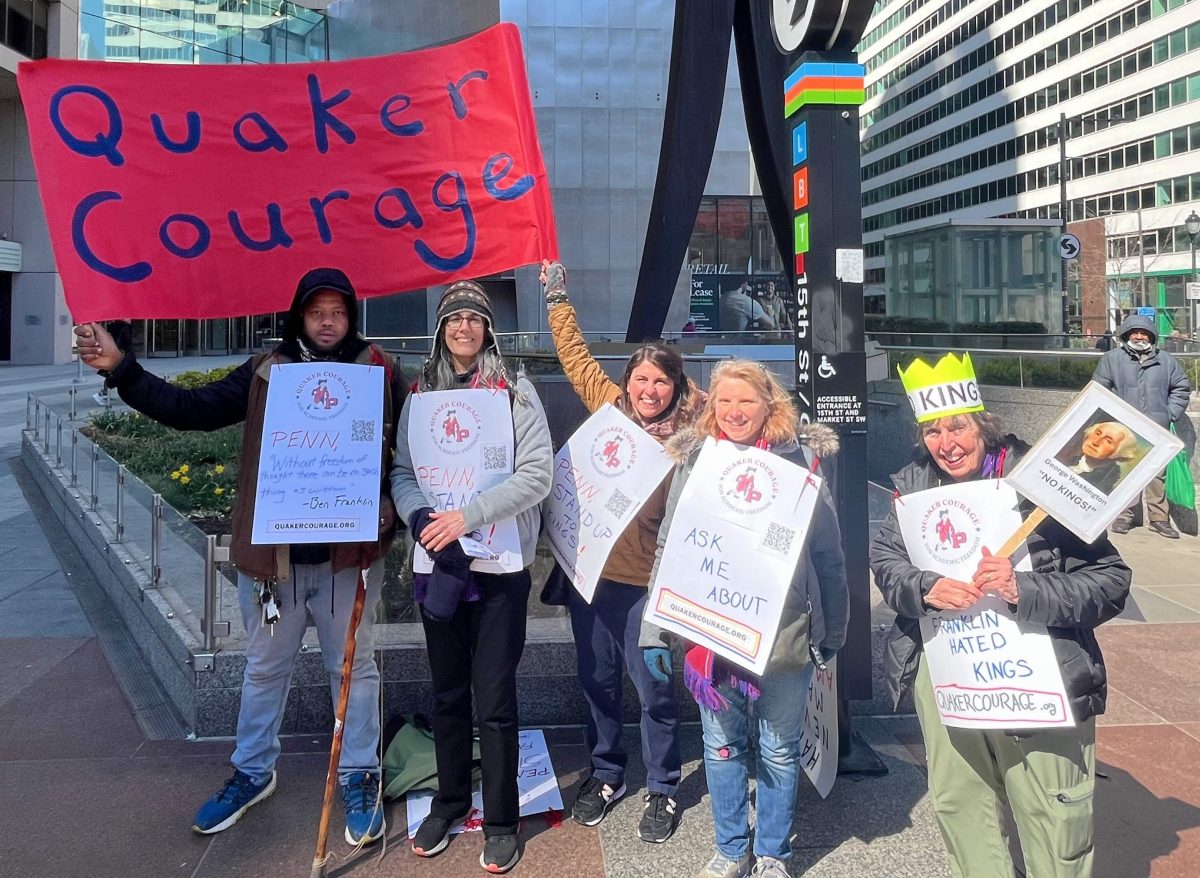
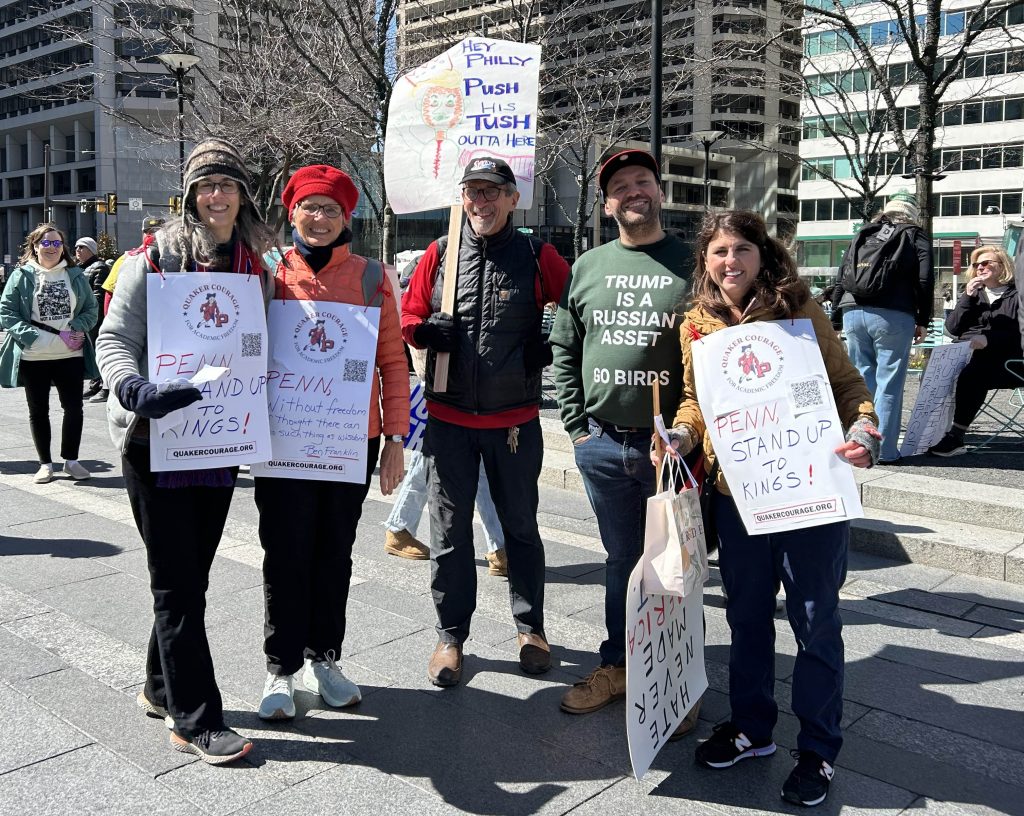
March 28, members and friends of Quaker Courage joined with about 40,000 other people to march from Philadelphia’s City Hall toward the Art Museum. Our group spread the word about Quaker Courage and our goal to help Penn stand up to the Trump administration.

During the March 28 event we wore fun signs with the Quaker Courage logo, a QR for the petition, our web site address, and a variety of messages including “What’s up, Penn?”, “Fascist fear academic Freedom”, and “‘Without freedom of thought there can be no wisdom.’ — Ben Franklin”

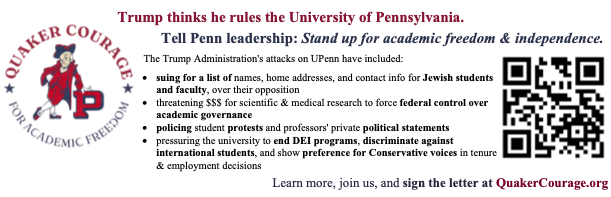
Together we handed out hundreds of flyers explaining the key issues we are watching and requesting signatures on our letter to Penn President J. Larry Jameson and the Board of Trustees.

Flyer handed out at No Kings 3 in Philadelphia

Within 24 hours of the No Kings 3 rally in Philadelphia, we added about 100 signatures to our letter.

Our next big event will be at Penn’s graduation and alumni weekend. Mark your calendars for May 15 – 18 and watch for more information.

Quaker Courage members at No Kings 3 in Philadelphia. March 28, 2026.

Federal Anti-DEI Edicts and Penn’s Responses

“The moment calls for courage”Chad Dion Lassiter, Executive Director, Pennsylvania Human Relations Commission and UPenn Social Work MSW graduate, quoted in the Philadelphia Inquirer, August 12, 2025

President Trump was inaugurated for the second time on January 20, 2025.

On January 21, 2025, the White House issued an executive order threatening the grant funding of higher education institutions that incorporate “diversity, equity, and inclusion” (DEI) programs.

By February 15, the Philadelphia Inquirer reported that Penn’s various schools had already started removing or rewording references to diversity, equity, and inclusion from their websites, at the direction of Penn’s highest-level administrators.

In contrast, Temple University and Drexel University indicated they would not make immediate changes to programming or language. (A quick glance at Temple’s website suggests the continued existence of programs declaring themselves as involving DEI. At Drexel, the description of an event held this month references Drexel’s “commitment to diversity, equity, inclusion, and belonging.”)

Then, in summer 2025, came Penn Carey Law School’s announcement that it would “pause” a full-tuition scholarship program named for Dr. Sadie T. M. Alexander, its first Black graduate. Furthermore, it would close its office of “equal opportunity and engagement” – formerly the office of “equity and inclusion,” which had evidently become forbidden words — by the end of August.

After an outcry from many quarters — including Chad Lassiter of the Pennsylvania Human Relations Commission, the agency that enforces PA state laws prohibiting discrimination; Sadie Alexander’s daughter Rae Alexander-Minter; the Philadelphia NAACP; the Penn Carey Black Law Students Association; and the Penn chapter of the American Association of University Professors (AAUP) – Penn Carey Law announced a new, two-year post-graduate fellowship program to be named for Sadie Alexander.

Two Penn Carey Law graduates, J. Huntley Palmer and Patricia L. Petty, in an Inquirer op-ed, point out, “Funding a two-year postgraduate fellowship is not remotely comparable to full tuition scholarships for three years at Penn Law, a current approximate value of $240,000, for up to five incoming law students.” A postgraduate fellowship does nothing to lower the barrier to entry for Black students applying to and attending Penn Law. As reported in The Daily Pennsylvanian, the number of Black students who enrolled in the 2025-26 first-year class is 50 percent lower than in the previous class, and the lowest number since the American Bar Association began requiring the disclosure of such data in 2011.

The decision to create the fellowship suggests that advocacy has an impact, that University leaders are sensitive to community reaction, but the choice seems designed to appease critics while still undoing a valuable scholarship program that benefited our country by enabling talented students to enter the field of civil rights law.

Palmer and Petty also noted that Georgetown University Law Center responded very differently to DEI-related threats from the Trump administration. In February 2025, the Georgetown Law dean received a letter from interim U.S. Attorney for Washington D.C. Ed Martin saying that Georgetown Law graduates would no longer be considered for positions in the U.S. Attorney’s office unless the school ceased teaching or promoting DEI. The dean replied unequivocally, stating in his return letter that “the constitutional violation behind this threat is clear.” A search of Georgetown Law Center’s website reveals that the school continues to have an Office of Equity and Inclusion, and the Office’s web page invites donations to “Support Diversity, Equity, and Inclusion at Georgetown Law.”

The swiftness of Penn’s attempts to comply with Trump’s executive orders suggests that Penn’s AAUP chapter was not exaggerating when it called the University’s response “anticipatory obedience”. Lassiter of the Human Relations Commission – who earned his master’s in social work from Penn in 2001 – said that Penn needed to share its thinking behind the swift changes, and that complying with federal government orders or pressures is not an adequate explanation. (https://www.inquirer.com/education/penn-law-school-scholarship-equal-opportunity-criticism-20250812.html)

“The moment calls for courage,” Lassiter said.

We at Quaker Courage could not agree more. While we recognize the dilemma faced by academic leaders whose institutions’ research and programs – some of which benefit members of marginalized communities – could be slashed by threatened funding cuts, we’ve seen time and again that when institutions of any kind bend to autocratic lawlessness, they embolden more of the same. Law schools, of all institutions, must be willing to fight in court for our constitutional rights.

Summary of Quaker Courage Second Meeting

Sunday, February 15, Quaker Courage had its second meeting. Eight alums and one law student attended. All of us are motivated by a desire to see Penn live up to its values in the face of pressures from our federal government.

During the past month, we (Shobhi and Sharon), have begun connecting with two other Penn-based organizations, Stand Up Penn and Alumni for Freedom and Democracy. Participants in this meeting included representatives from both organizations. 

We engaged in further discussion and refinement of Quaker Courage’s mission. Core themes the group seemed to agree on are support for freedom of speech, academic freedom, and resisting government overreach — that is, the government’s attempts to arbitrarily control the policies and operations of institutions like Penn. (A lively discussion unfolded regarding the complexities of “freedom of speech” and controversies on campuses about what kinds of speech an institution should allow. Quaker Courage is concerned primarily with resisting government’s attempts to dictate such matters.)

We discussed possible actions to further our mission. There was lots of enthusiasm for the three organizations working together to plan events at Penn this spring, during the weekend of Commencement and Reunion. Possibilities mentioned include a rally, making signs for alums to carry during the parade of classes, holding a forum or presentation, and setting up a table where folks could engage in conversation with us about the issues Penn is facing in its relationship with the government.

This idea, and other possibilities for collaboration, will be discussed further by leaders of Quaker Courage and Stand Up Penn at a joint meeting scheduled for February 19. Watch for follow-up emails from us regarding action plans and a date for our next QC meeting.

Penn seeks to protect privacy of Jewish faculty and staff

Quaker Courage applauds Penn’s efforts to protect the privacy of Jewish faculty, staff, and students. Penn is fighting a subpoena demanding names, addresses, and other sensitive information about Jewish faculty, staff, and student workers on campus.

We encourage you to join our Penn Pens letter writing campaign and thank Penn President Jameson and Board Chair Raghavendran. You can also sign a petition that started on campus. Read on for details about the issue and the petition.

According to a November 18, 2025 complaint that the Equal Employment Opportunity Commission (EEOC) filed in Federal Court against Penn, the school is not fully complying with a subpoena.

In the filing, the EEOC states that they opened an investigation December 8, 2023, alleging that Penn was “subjecting Jewish faculty (including tenured, non-tenured, and adjunct professors), staff, and other employees (including, but not limited to, students employed by the university) to an unlawful hostile work environment based on national origin, religion, and/or race.” As part of their investigation, the EEOC subpoenaed Penn to “produce information relevant to the EEOC’s investigation of potential unlawful employment practices.”

Four days after the EEOC filing, on November 21, the New York Times reported that “Hundreds of students and faculty and staff members at the University of Pennsylvania signed a petition this week in support of their university’s refusal to turn over to the Trump administration names, phone numbers and physical addresses for some Jewish employees.” According to the article, Amanda Shanor, Associate Professor at Wharton, was one of those coordinating the petition.

On January 13, 2026, the ACLU of PA filed a motion to intervene in EEOC v. UPenn, on behalf of 5 Penn orgs: American Academy of Jewish Research, Jewish Law Students Association of Penn law school, the American Association of University Professors (AAUP), Penn’s chapter of AAUP, and the Penn Association of Senior and Emeritus Faculty.

Penn responded to the complaint with a January 20, 2026 filing. Penn affirmed that they complied with most of the subpoena. However, to protect the privacy of Jewish faculty, staff, and students, they were not including sensitive information with names, addresses, and other identifying information that the EEOC requested. In the filing, Penn wrote:

The issue presented in the EEOC’s application is narrow but exceptionally consequential. Penn has cooperated for more than two years with the EEOC’s investigation, producing nearly 900 pages of materials. The sole dispute is over the EEOC’s extraordinary and unconstitutional demand that Penn assemble and produce lists of employees that reveal their Jewish faith or ancestry, associations with Jewish organizations, affiliation with Jewish studies, participation in programming for the Jewish community and/or de-anonymized responses to surveys on antisemitism, alongside their personal home addresses, phone numbers, and emails. The EEOC insists that Penn produce this information without the consent—and indeed, over the objections—of the employees impacted while entirely disregarding the frightening and well-documented history of governmental entities that undertook efforts to identify and assemble information regarding persons of Jewish ancestry. The government’s demand implicates Penn’s substantial interest in protecting its employees’ privacy, safety, and First Amendment rights.

One January 21, 2025, one day after Penn’s court filing, over 150 Penn Jewish faculty filed a brief in support of the University’s response to the lawsuit.

The litigation is ongoing. The EEOC was not impressed by the privacy issues Penn raised, nor the support Penn has received from so many different sources. On January 27, 2025 the EEOC responded with a new court filing. Their filing states that,”Rather than comply with EEOC’s requests aimed at identifying possible victims of and witnesses to a hostile work environment based on religion, national origin, and race, Respondent has instead chosen to undertake an intensive and relentless public relations campaign against the EEOC.”

Join Quaker Courage second meeting! Sign up and bring a friend

Sunday, 2/15/26, 4:00-5:30pm on Zoom. Register here.

Since our goal is to help Penn live up to its aspirations, we want to familiarize ourselves with Penn’s stated goals. Prior to the meeting, please read Penn’s posted statements on the University’s values and the words that guide Penn:

Additional helpful actions:

  1. Email info@quakercourage.org a short paragraph about your concerns and what issues you are watching at Penn and universities/colleges elsewhere.
  2. Join our letter writing campaign! And encourage others to do so. Paper letters encouraged. If willing, share these for the QC website by emailing them to info@quakercourage.org, but delete anything you would not want posted on the website.
  3. Encouraging your Penn-affiliated friends to write a letter and to sign up for our Quaker Courage mailing list

Agenda for 2/15/26 meeting

Welcome and Introductions

What Quaker Courage has done so far

  • Website updates (slogan, new articles, menu changes)
  • Conversation with Aiden Ledbetter from Democracy House
  • Meeting with Crimson Courage
  • Planned meetings with Stand Up for Penn & Alumni for Freedom and Democracy
  • Scheduling meeting with Cornell Courage

Discussion inspired by homework from last meeting

  • Your thoughts on the Penn web pages
  • Did anyone write us a paragraph about their concerns and issues they’re following?
  • Did anyone write a letter to Penn leadership?

Identify next steps, plan and schedule next meeting

Summary of Quaker Courage First Meeting

Sunday, January 18, Quaker Courage had its first meeting. Nine alums attended representing classes from 1967 to 1985. Participants Zoomed in from Santa Barbara to Kansas City to Boston to Philadelphia. Some have been active with the Penn alumni community; others have not. All were motivated by concern about Penn’s ability to live up to its values under pressure from our current government.

Background

Quaker Courage (QC) is pretty new. We started the meeting with the history of the group—why it started, and what QC has done so far. We have a website, QuakerCourage.org, and an active letter writing campaign.

Concerns/goals brainstormed by participants:

  • Penn making changes to policies, academic curricula, or other practices *because* Trump & Co. demand it.
  • Limiting rights of students under the guise of fairness (anti-DEI, trans, scholarships for minorities; so-call antisemitism efforts that are not that; limiting free speech of students, faculty or staff.)
  • Would like to know what alumni understand as the purpose of the university, how that purpose is realized in their life experience; how they see the university aligned with that.
  • How to support UP when under pressure from the Trump administration; gather info on what other universities/alums are doing and consider replicating/adapting; organize letter-writing to Congress? to Shapiro?
  • Concern about the governments’ interference with admissions, hiring and firing of professors, defunding programs it doesn’t agree with as well as research, especially medical research at which Penn has been at the forefront. Democracy depends on universities and the press, and the curtailing of either is dangerous.
  • Harness alums to take action; how to create a dialogue with top univ administrators about their positions on topics; set top 3-4 priority topics for on campus positions on antisemitism, foreign students, academic freedom; role of protests and equal representation of viewpoints.

Quaker Courage Vision: 

Help Penn live up to its own vision and values. As they state on their website they are for “excellence, freedom of inquiry and expression, and respect. Penn’s culture is inspired by its founder, Benjamin Franklin—open-minded and curious, inventive and practical, exhibiting brilliance across fields, imperfect but self-improving, and relentlessly focused on enhancing social good.”

Actions we want to do now: 

  • Add content to our blog, especially around issues we are watching.
  • Find information about other Penn groups and build connections.
  • Get in contact with other college courage groups and link their websites on our quakercourage.org blog
  • Come up with good motto and tagline
    • Since the meeting, updated blog tagline to “Leges sine moribus vanae – Laws without morals are useless”
  • Write our own letters to university leadership.
  • Expand outreach efforts to grow our membership

Homework before next meeting (Feb. 15, 4pm)

  • Read Penn’s statement on their values and words that guide them
  • Join our letter writing campaign. Paper letters encouraged!  If willing, share these for QC website by emailing them to info@quakercourage.org, but first delete anything that you do not want posted on the web.
  • Email info@quakercourage.org a paragraph about your concerns and what issues you are watching at Penn and universities/colleges elsewhere.

Sign up for the next meeting (Feb. 15, 4pm on Zoom)  and bring a friend.

Penn Scrubbed References to Diversity, Equity and Inclusion in 2025

Penn and the other Ivy League institutions made a huge mistake in February 2025. Apparently, our leaders had not read Timothy Snyder’s essential book “On Tyranny.”  Snyder’s first two lesson are “Do not obey in advance” and “Defend institutions.” When threatened with loss of Federal funds, Penn immediately went beyond what was requested to meet Trump’s demands. It scrubbed all references to Diversity, Equity and Inclusion from web sites, department, staff titles, program description and outreach initiatives. Overnight the DEI office became the “Office of Academic Excellence and Engagement.” Penn officials apparently were intimidated by the unwarranted forced resignation of Pres. Liz McGill the previous year instigated by Penn Trustee Marc Rowan, a designer of Trump’s “Project 2025” plan to attack the nation’s elite institutions.

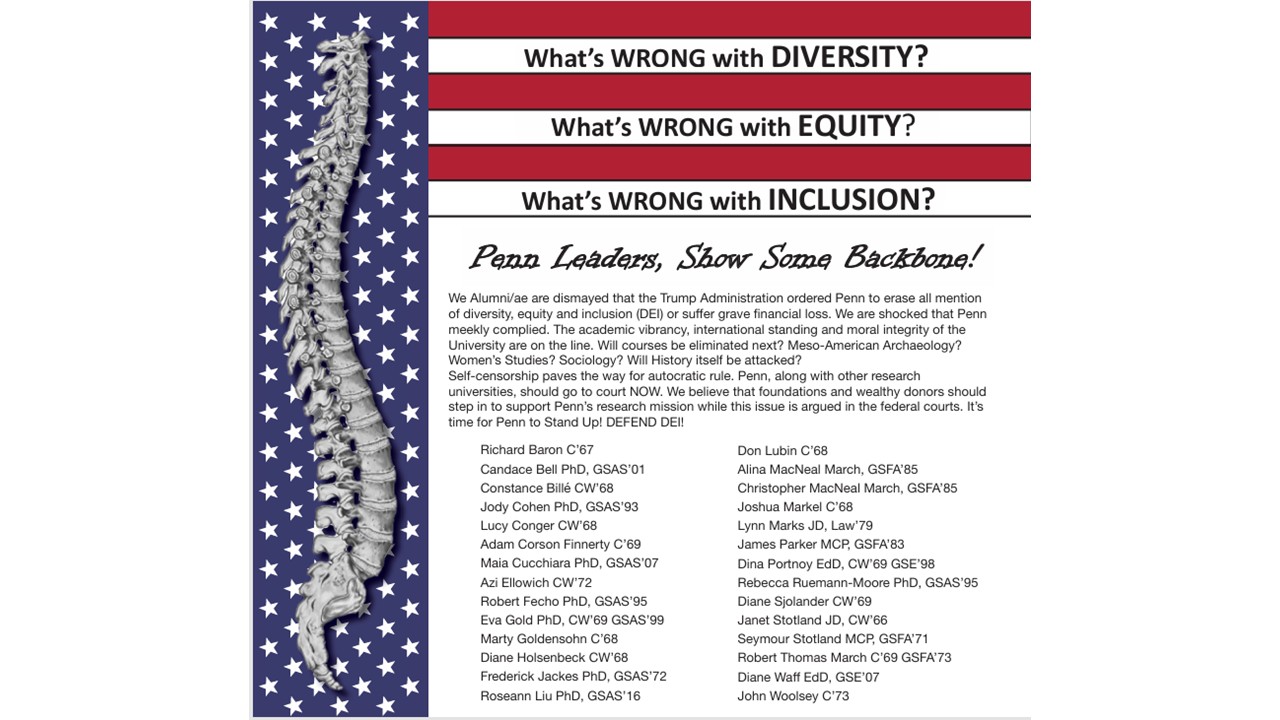
A group of alumni with experience in resisting the University in their student years immediately responded by buying a half page ad in the Daily Pennsylvanian that places a Spine on a flag and asks “What’s wrong with Diversity…Equity… Inclusion?

During Homecoming in November 2025, one of our Quaker Courage  members asked the same question of the Chair of the Trustees, Ramanan Raghavendran.  He responded that the university “certainly does not embrace the opposite of those principles – monolithic, inequitable and exclusionary.” That was a decent answer though lacking in specifics. We also learned the next day that Rowan is leaving the Trustee board.

Content of the DP ad: 
What's Wrong with DIVERSITY?
What's Wrong with EQUITY?
What's Wrong with INCLUSION?